
Let’s be honest with each other for a minute. Every one of us has an “annual patient.” Good cop, well-liked, a few years from retirement, and he shows up on qualification day like he’s reporting for his own funeral. He fails, we put him through a “remedial” session, he scrapes out a passing score, and we shake his hand and say, “See you next year.”
And then we see him next year. Same guy, same problem, same handshake.
Here’s an uncomfortable truth we must all recognize and accept: qualification measures proficiency; training builds skill. If all we do is run the course until the number turns green, we haven’t fixed anything. We’ve produced a score. A single “cram session” doesn’t beat the fact that shooting is a perishable skill. Without practice afterward, that officer drifts right back to where he started.
This isn’t a knock on you. Most instructors wear a dozen hats, we’re short on range time, and the agency often just wants the qualification box checked. But inside those limits, there’s a better way to work. I’ve boiled it down to a formula and an acronym you can carry to the firing line.
The Formula
Diagnose → Rebuild → Stress → Record → Retain
That’s the whole philosophy. Find out what is actually wrong before you run a single drill. Rebuild only what’s broken, and do it in order. Test the fix under pressure. Write it all down. Then stay with the shooter until the skill sticks.
To make it easier to remember on a hot range with a clipboard in your hand, here it is as an acronym:
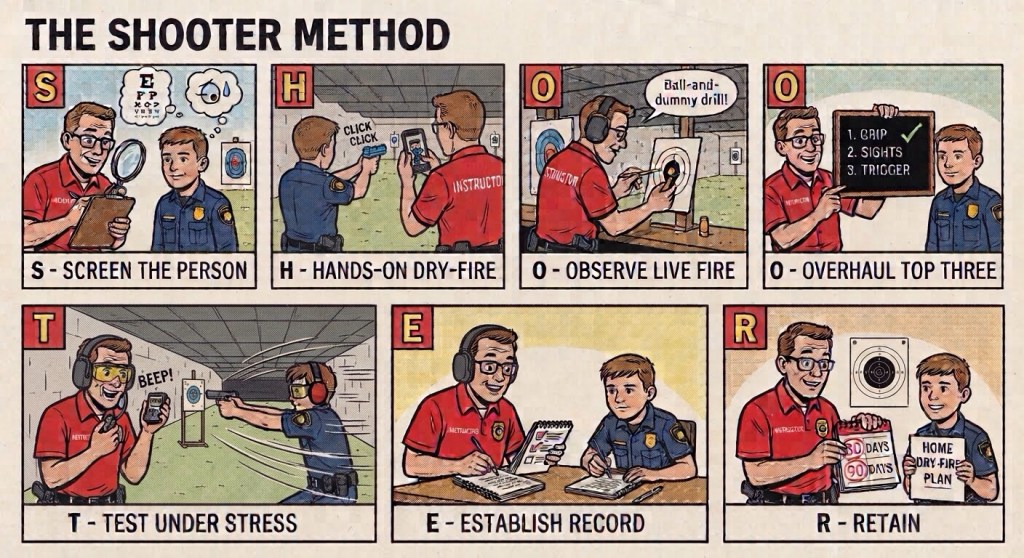
The SHOOTER Method
S – Screen the person. Look at the human first, not the target. Vision, dominant eye, gear fit, pain, age-related limits, and the mental picture (stress and pre-shot anxiety).
H – Hands-on dry-fire analysis. Isolate the mechanics where nothing makes noise or recoils and nothing is hiding. Use video.
O – Observe live fire. Shoot for a diagnosis, not a score. Read the target, run the ball-and-dummy drill (it’s the miracle cure).
O – Overhaul the top three. Rank the errors, then rebuild in order: grip, sights, trigger (or whatever the observed issues are). Identify three priorities, no more.
T – Test under stress. Add a timer, a little competition, or a decision to make, so the fix survives pressure.
E – Establish the record. Goals, memos, checklists, journals, and clear notes on what you tried and how the student responded. Have the student create a journal, as well.
R – Retain. Set 30-day and 90-day checks, a home dry-fire plan, and a re-assessment date.
SHOOTER. Seven letters. Now let’s put a real-feeling student through all seven.
Meet Officer Don T Shootalot
Don is a fictional 41-year-old officer with nine years on the job. Everyone likes him. He’s a decent cop and a better coworker. He’s also a problem we all recognize:
Failed the last two qualifications on the first attempt (he needed an 80 and shot a 74 this time).
He passes after a “remedial” session, usually with a low 80s score.
His shots print low and left, and he runs out of time on the timed stages.
He’s visibly tense on qualification day, volunteers for the last relay, and never asks questions.
He doesn’t touch his gun or the range unless he’s ordered to.
He wears reading glasses and tends to ask for directions to be repeated.
The lazy read is “Don can’t shoot.” The better read is that we don’t know yet. Is it trigger control, vision, grip, nerves, or all of the above? Chances are good it’s a combination, and we may not sort it all out in one session. That’s exactly why we’re not going to treat this as a one-session fix.
A note on his age bracket, too: Don is a Millennial, and in my experience that means he’ll buy in once he understands the why. If I just yell “press the trigger straight back,” I get polite nodding. If I explain what the muzzle is doing when he jerks it, I get a student.
S: Screen the Person
Before Don fires a round, I want to look at him, not his target. Think of this as the part where you earn his trust and find the hidden barriers.
The setup. I sit down with him for fifteen minutes. No yelling, no qualification clipboard. I tell him plainly what we’re doing: “We’re not trying to get you a passing score today. We’re trying to find out what’s really going on so you don’t have to do this every year.” That one sentence takes the temperature down.
What we check:
Vision. I confirm his dominant eye. I ask when he last had his eyes checked and whether his current reading glasses are compatible with how he sees his sights. (A red dot can ease some eye-dominance and near-vision issues, but that’s a conversation for the department’s equipment policy.)
Gear fit. I hand him the duty pistol and watch his hand on it. His trigger finger sits deep in the guard and his support hand can’t fill the gap. Medium backstrap was installed. Don has smaller hands than the average officer. That’s an equipment problem, not a shooter problem. We swap to the small backstrap. Easy win, and it tells him it’s not all his fault.
Physical reality. Any pain, nerve issues, arthritis, grip strength changes? Don mentions a little tingling in his right hand after a long shift. I note it and suggest he mention it to his doctor. I’m not a physician, but I know to document it and not to guess.
The mental picture. I ask how he feels walking onto the range. He says, “Honestly, my stomach drops in the parking lot.” There it is. Qualification anxiety is on the table.
Breathing. While he dry-fires later, I watch for shallow, rapid, or held breathing.
The “why” for Don: I tell him, “A lot of what shows up on target is a symptom. We’re going to check the cause.”
At the end of screening, my notes say: gear fit corrected; possible anxiety component; hand tingling flagged; vision needs follow-up. Good. Now, let’s get a weapon in Don’s hand.
H: Hands-On Dry-Fire Analysis
Dry-fire is where we expose weaknesses without noise, recoil, or the pressure of a score. If he can’t execute a perfect shot here, he’s not going to do it on qual day or on the street.
Safety first. Unloaded, cleared firearm, and no live ammunition in the training area. I verify it. Every time. And I’m not assuming Don knows the rules for home practice, so we’ll cover those before he leaves.
Smartphone as a coach. I prop a phone on a stand and record his presentation and trigger press. Here’s why this matters: when you tell a student what he’s doing wrong, he’ll often say, “No, I’m not.” The camera doesn’t argue. Slow-motion playback magnifies the problem and makes it undeniable. It also gives us a video log of his progress.
For each drill, I keep four elements in mind:
Factor: What exactly am I evaluating?
Criterion: What task am I measuring?
Scoring: Acceptable/unacceptable, or a number?
Error identification: Can he see it? Can I explain it?
What the video shows. As Don presses the trigger, his support hand loosens and his grip shifts. The front sight dips. The “hole” in his grip from the old backstrap is mostly gone, but the habit is there. He also holds his breath right before the press.
I show him the clip and ask him what he sees. He says, “My hand’s moving.” That’s the breakthrough. A self-diagnosis sticks far better than one I hand him.
O: Observe Live Fire
Now we find out what happens when the gun goes off. I’m not shooting for a score. I’m shooting for a diagnosis.
Read the target. I start at 5 yards and back up in increments. Don’s group sits low and left. Remember the patterns:
Low-left (right-handed shooter): most common. Jerking the trigger or fighting recoil.
High-right: heeling the gun, pushing with the heel of the hand at shot break.
Horizontal stringing: inconsistent sight alignment or grip.
Scattered: unstable grip, lost front sight, or something mechanical.
Low-left is where my suspicion falls, but a low-left group alone doesn’t tell me why.
Ball and dummy. This is still my favorite diagnostic. A partner loads a magazine with a random mix of live and dummy rounds (I use five and five), loads it without Don seeing, and calls the drill. Don runs the drill until a dummy round comes up.
When the striker falls on a dummy and the muzzle dives, the flinch is undeniable. Don’s muzzle drops hard. He laughs a little, then goes quiet. “I didn’t know I was doing that.” Now we have a name for it: anticipation.
A practical note: once a shooter has done the drill a few times, he starts expecting the dummy and it loses power. When that happens, I slip a couple of dummies into later timed drills to lock in the correction.
Final analysis. At the end of the session, I rank what I saw:
Anticipation/flinch (confirmed by ball and dummy)
Inconsistent support-hand grip during the trigger press (confirmed on video)
Pre-qualification anxiety feeding both
That’s it. Three. Not ten. I’m not trying to fix the whole shooter, only the specific failures I’ve identified.
I also keep an eye on how Don is doing mentally. When he gets frustrated, I don’t yell and I don’t life-coach. I ask him to explain, in his own words, what he thinks just happened. When he can articulate it, the mental barrier starts to crumble. I find that having him write his personal observations in his own words, immediately after he makes them, to be extremely beneficial.
O: Overhaul the Top Three
Here’s where sequence matters. When we read a target, our first instinct is to blame the trigger finger. It’s the most common correction on any firing line. But the trigger problem is often a symptom of something else, which is why I diagnose and rebuild in this order: grip, sights, trigger.
Grip first. Don’s support hand is the weak link. We go through the points of contact: high on the backstrap, support palm filling the open space, support hand canted forward, firm lateral compression like a vise. If a student is violating three or more points, I’m looking at a fundamental grip failure. For Don, the new backstrap helps a lot, and now he can actually build the grip.
I explain the why: “The grip is what keeps the gun steady while only your trigger finger moves. If the grip changes during the press, the gun goes where the grip moves it.”
He practices building the grip close to his body during presentation. Short reps, quick feedback, no lectures. I’m using the 15-minute block idea here: a few minutes of explanation, then mostly practice.
Sights second. I have him focus on the front sight and let the target blur slightly. I ask him what he sees. He catches himself “peeking” to look for the hit, and we work on staying on the sight through the shot. Of course, if Don has pistol mounted optics we must change our instructions to ensure he is properly using the dot.
Trigger last. This is the hardest skill for a remedial student, because the brain wants the hand to squeeze as a single unit. I use the “come here” finger motion. He watches his own finger curl, sees how it isolates one joint and moves straight back, and I explain how that naturally prevents sympathetic grip tension.
Then the coin drill. In dry-fire, I balance a coin on the front sight and tell him to press the trigger without dropping it. It’s objective feedback: the coin falls or it doesn’t. Don gets competitive about it, which is a good sign. Add the Wall Drill for dry-fire reps, and he has real work to do.
Breathing. For the anxiety piece, I teach him box breathing: in for four, hold four, out for four, hold four, repeated four times. I tell him to use it in the parking lot before the range, not only when things go wrong. That’s the “reset button” for when his focus starts to slip.
Before we finish, I give him a targeted proficiency test, a drill built to check whether he can now see and correct his own errors. We’re not running the qual course. We’re checking understanding of the rebuilt skill.
T: Test Under Stress
Most of the remediation I’ve seen stops right here, after the shooter is able to get a “qualifier.” That’s the mistake. We owe Don the next phase.
And let’s be clear about what stress means. Push-ups and burpees make a shooter tired. That’s physical fatigue, and it has its place, but it isn’t stress inoculation. The goal is to teach him to manage adrenaline, tunnel vision, and the loss of fine motor skills when the brain perceives pressure. So we add mental stress, in steps:
A shot timer. Compressed time creates pressure. We start with a generous par time and tighten it as he succeeds.
A little competition. I bring in another shooter for a friendly head-to-head. Social pressure is part of what bites Don on qual day.
A decision to make. Turning targets or a simple shoot/don’t-shoot element so his brain has to process information while keeping the fundamentals.
On his first timed run, the old habits come back. The flinch creeps in and the group drifts left. I don’t dump on him. I slip a couple of dummy rounds into the timed strings (that’s the “lock-in” trick from earlier), and I remind him of the box breathing between strings.
I also watch for system overload: rapid breathing, flushed face, trembling, delayed response to commands, stepping ahead of the line, irritability. When I see it, I don’t pile on. I back the difficulty down a notch, let him finish the drill safely, then ask him what he thinks went wrong and how to fix it. If he owns the solution, he’s more likely to remember it.
By the end of the session, Don is shooting tighter groups under time pressure than he’s ever shot on qual day. He’s also noticeably calmer. That’s what we were after.
E: Establish the Record
If you take one thing from this article, let it be this: if it isn’t written down, it’s just a wish.
Here’s a story every instructor should think about. Picture another officer, let’s call him Fred. He fails qual. You take him aside for fifteen minutes, apply a quick fundamentals band-aid, he squeaks through, and you never write it down. Later, Fred is involved in a shooting where he misses with every round, and an internal investigation finds a history of low scores that always get “fixed” after undocumented sessions. Fred implies it’s not his fault; the instructor knew he had issues and never offered additional training.
Suddenly you’re the one explaining. Being helpful can be a double-edged sword when nothing has been properly documented.
For Don, I build a defensible record from day one:
The administrative foundation: the formal memorandum and email notification so Don, his supervisor, and the training staff are on the same page about what’s required.
A goal statement: “What do I expect this program to do, and what should the student expect?” For Don: identify and correct the technical issues and bring him to a proficiency level that meets or exceeds safety and qualification standards.
The diagnostic core: my proficiency checklist, drill results, and notes on the three priority errors.
Journals: I keep one, and Don keeps one. Notes on goals and outcomes, thoughts on what happened, and conclusions or next goals. His journal captures the “aha!” moments (like the coin drill) that a form will never record.
Video log: the smartphone clips show where he started and the milestones he hit.
The record also protects the process. I follow what I like to call the “two-instructor, two-opinion” idea: before anyone even discusses a termination of training, at least two different instructors should have tried the remediation protocol. That way a failure is truly a performance issue and not just a clash of teaching styles.
R: Retain
Here’s the phase I see agencies skip most. Don gets his passing score, and most departments would call it done. We’re just getting started.
The skill maintenance plan. Something documented, with a structured schedule, specific drills, and a stated duration. For Don:
Ten minutes of dry-fire, four days a week: grip build, coin drill, Wall Drill.
A quick phone video once a week to check his work. (If he’s stuck on a draw stroke, a five-minute video call can save a week of guessing.)
One voluntary range session each month with a few mixed dummy rounds.
A short journal entry after every session.
The timeline. Here’s what I’ve generally seen from consistent dry-fire practice (this is experience-based, not lab-tested, so give your shooters the honest framing): in one to two weeks, noticeable improvement in trigger control; in four to six weeks, the flinch nearly gone and tighter groups; and with about ninety days of consistent work, a marginal shooter can become a solid one. The keys are consistency and correct execution, not marathon sessions.
Accountability. I send short progress emails to Don, his supervisor, and the division commander. Positive reinforcement matters, and it creates a paper trail that shows the program is working. I tell Don I’m available any time, because instructor continuity matters.
Check-ins. At 30 days, we meet. Don’s groups are centered and his flinch rate on the occasional dummy round is way down. At 90 days, we re-assess and run a stress drill again. The tingling in his hand has been looked at by his doctor, and a new pair of glasses has helped his sight picture.
And the result? At next year’s annual qualification, Don doesn’t ask to shoot on the last relay. He qualifies on his first attempt with a score in the low 90s. He’s also been showing up to voluntary range sessions and has started scheduling his own lessons. In other words, he’s moved from the remedial column to the coaching column, which is the real goal.
The Short Version
If you remember nothing else, remember this:
Assess before you repeat. One size does not fit all. Drills applied without a plan are a waste of ammo and can reinforce bad habits.
Diagnose in order: grip, sights, trigger. The trigger is often a symptom.
Let the student diagnose himself. Video, questions, and objective feedback beat lectures.
Stress-test the fix. A fix that only works when no one’s watching isn’t a fix.
Write it down. Documentation is your accountability, your defensibility, and the student’s map to proficiency.
Don’t end at the score. Remediation ends when you have a maintenance plan, not when the number turns green.
So here’s my challenge. Next time one of your annual patients walks onto the range, ask yourself: Is my program a process, or just an event? If it’s more event than process, don’t be discouraged. That’s usually a systemic problem, not a personal one. Start small. Document your diagnostics. Build a plan for accountability. And remember that every good rep is one step toward an officer who’s ready on the day their capability decides who goes home.
Don Shootalot is a fictional composite created for illustration. Dry-fire practice should always be conducted with a verified unloaded firearm and no live ammunition in the training area. Concerns about a student’s hand, vision, or other medical issues should be referred to the appropriate professional.
“We are what we repeatedly do. Excellence, then, is not an act, but a habit.” – Aristotle
Semper Optimum


Leave a Reply