Article by Leo H.
A common problem seen during qualifications occurs when students focus on completing the required string of fire rather than making deliberate, accountable hits. When asked to “call the shot,” some students cannot identify where their rounds landed. They know only that they fired the prescribed number of rounds within the allotted time in the general direction of the target.
This problem is reinforced by large silhouette targets and forgiving scoring zones. A qualification course can reward keeping rounds somewhere on the target without adequately measuring whether the shooter can place accurate, tactically significant hits under pressure. Qualification should not be a measurement of how quickly a magazine can be made empty. It should assess whether an officer can recognize a deadly threat, select an appropriate aiming area, fire accurately within the available time, and continue evaluating the situation after each string.
The Problem with Forgiving Standards
Most law-enforcement qualifications are conducted on large silhouette targets. On the SQT-A1 target used for Georgia’s mandated qualification, hits in the center-mass zone receive 10 points, while hits elsewhere on the silhouette receive 8 points. With a passing threshold of 80 percent, a student could complete the 30-round course without a single center-mass hit and still qualify.
That scoring system emphasizes keeping rounds on the target rather than consistently placing them in areas most likely to disrupt an aggressive action. It may measure basic gun-handling and time management, but it does not necessarily measure the level of precision required during a lethal-force encounter.
Advice such as “It is better to hold the round than to shoot a zero” and “Do not train yourself to fail on the street” is often ignored when the course rewards speed and volume of fire more than shot accountability. A shooter who does not know where the rounds went cannot reliably evaluate performance, diagnose errors, or make meaningful adjustments.
The issue is not that every qualification must demand surgical precision. Officers may be required to shoot under poor lighting, from awkward positions, while moving, or while dealing with competing threats. The issue is whether the qualification standard reflects the officer’s actual responsibility of making justified, purposeful shots that have a reasonable probability of stopping an imminent threat.
What Should a Qualification Measure?
When an officer chooses to fire, the decision is based on facts and circumstances which lead the officer to recognize that a person poses an imminent threat of death or serious bodily injury to the officer or others. The officer then makes the decision to utilize a firearm to stop that threat as quickly as reasonably possible while continuing to act within law, policy, and sound tactics.
A meaningful defensive-handgun standard should therefore measure more than the ability to fire a specified number of rounds within a time limit. It should evaluate whether the shooter can:
- Recognize and respond to a legitimate threat.
- Select an appropriate aiming area.
- Make accurate, accountable hits under time pressure.
- Manage recoil and recover the sights.
- Reassess after each string of fire.
- Continue fighting only while the threat remains active and legally justified.
- Maintain awareness of cover, movement, other people, and changing conditions.
The standard should reward the fastest accurate performance -not merely the fastest movement of the trigger finger.
Why Shot Placement Matters
Except for a direct hit to the medulla oblongata, no gunshot wound guarantees immediate incapacitation, as the highly unpredictable physiological consequences depend on a complex mix of anatomical structures, bullet dynamics, and situational factors that frequently allow individuals to maintain purposeful action despite severe, life-threatening injuries. The practical lesson is not that officers should expect a single shot to end every encounter (STOPPING POWER). Rather, officers should understand that hits in tactically significant areas may offer a greater probability of rapidly disrupting the threat than peripheral hits. They must also be prepared for the possibility that an adversary remains capable of purposeful action after being shot.
A defensive-handgun program should therefore emphasize accurate placement in smaller, meaningful aiming areas while also teaching officers to maintain cover or movement, reassess, and continue responding until the threat has clearly ended.
Training for Precision Under Time Pressure
A large target allows a shooter to fire quickly while masking deficiencies in sight alignment, trigger control, recoil management, and visual processing. If nearly every shot fired leads to a passing score, the shooter may never accept that many of the hits that resulted in acquired points toward a “qualifying’ score would have had no tactical effect in a real-world gunfight.
Smaller aiming areas encourage a different standard. They require the shooter to see an appropriate reference point, press the trigger deliberately, and accept that an unaccountable shot is not automatically a successful shot. This does not mean that every drill should be slow or artificially precise. Training must still reflect the time pressure and uncertainty of actual encounters.
The shooter should practice a process that includes:
1. Recognizing the threat.
2. Deciding whether deadly force is justified.
3. Selecting an appropriate aiming area.
4. Firing accurate shots at the fastest pace that permits acceptable accuracy.
5. Reassessing the target and surrounding environment.
6. Continuing to fire only as long as the threat remains active.
These decisions may occur within seconds. A shooter who takes six seconds to fire three highly accurate rounds may not be prepared for the time frames normally associated with a street-level confrontation. Conversely, a shooter who fires three rounds in one second but cannot account for their placement may be creating additional danger without reliably stopping the threat.
The appropriate goal is neither maximum speed nor maximum precision in isolation. It is the fastest pace at which the shooter can make accurate, tactically meaningful hits.
Choosing Appropriate Aiming Areas
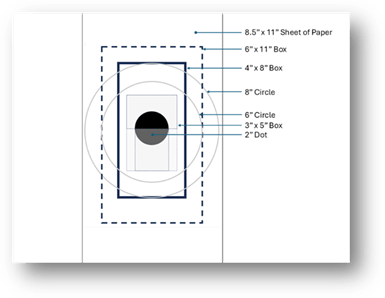
A training target should provide clear aiming references without implying that any particular zone guarantees a specific medical result. Several commonly used dimensions can help shooters develop the precision required for defensive handgun work:
- An 8.5-by-11-inch sheet of paper: Useful as a general head or upper-torso reference. It provides a smaller area than a full silhouette while remaining practical for basic drills.
- A 6-by-11-inch rectangle: Useful as a centered upper-torso aiming area that demands more precision than a conventional silhouette.
- An 8-inch circle: Commonly used as a demanding upper-torso training zone and often associated with the NRA B-8 target’s outer scoring area.
- A 6-inch circle: Appropriate for more precise upper-torso drills.
- A 4-by-8-inch rectangle: Useful as a narrow upper-torso or sternum reference.
- A 3-by-5-inch rectangle: Useful as a small central head-zone reference.
- A 2-inch aiming point: Appropriate for advanced precision work and should not be confused with a universal expectation for every operational engagement.
These shapes should be understood as training references, not guarantees of immediate incapacitation. Their purpose is to help shooters develop visual discipline, accountability, and the ability to make accurate hits on smaller areas under realistic conditions.
LEOS Target (Law Enforcement Officer Standards – Target)
Suggested Usage
You can use this type of target for both accuracy and decision-making drills. For example, you could use different colors of paper to designate different actions; you might begin with a larger zone and then progress to smaller zones; add longer distances, movement, reduced lighting, cover, or multiple targets. The goal should be to preserve accountability as the conditions become more complex.
Reality-Based Training
Training targets should help shooters visualize the consequences of poor placement, but they should not suggest that anatomy functions like a collection of guaranteed shutoff switches. A hit in a critical area may stop aggressive action quickly, but it may also fail to produce immediate behavioral change. The shooter must remain prepared to deal with a still-functional opponent for several critical seconds, even after a well-placed shot.
Training should also avoid turning an average number of rounds into a fixed engagement formula. Some retrospective analyses have reported that confrontations ending after gunfire often involve approximately two or three rounds, but such figures do not establish how many rounds are required in every encounter. Individual outcomes vary widely.
The correct lesson is to fire accurate, purposeful shots and reassess continuously… not to fire an assumed number of rounds and stop firing automatically while expecting favorable results.
Practical Training Materials
Anatomical targets can be valuable, but they are not always necessary or affordable. Smaller aiming areas can be created with inexpensive materials such as:
- NRA B-8 targets
- Index cards
- Playing cards
- Printed rectangles and circles
- Paper or cardboard overlays
The important feature is not the type of target. Instead, it is whether the target encourages the shooter to aim at a defined area, account for every shot, and perform within a realistic time frame.
A round that scores points on a large silhouette but misses the intended aiming area should prompt analysis rather than praise. Was the shot pulled because of poor trigger control? Was the shooter moving too quickly? Was the target too small for the chosen distance and time? Did the shooter fail to confirm the sights? Those questions produce useful training. A pass-or-fail score by itself may not.
Conclusion
Law-enforcement qualifications should reward accountable hits in tactically meaningful areas, performed under realistic time constraints. Large silhouettes may be useful for introductory work, but they should not be the only measure of defensive-handgun proficiency.
Officers should train to recognize a threat, make a justified decision, select an appropriate aiming area, and fire as quickly as they can produce accurate, tactically significant hits. They should also be prepared for the possibility that an injured adversary remains capable of action and should continue to assess the threat, their surroundings, and their own tactical position.
Speed without effective hits is not proficiency. Precision without practical time management can be useless. The objective is the combination of both: making the fastest accurate shots the situation allows while maintaining sound decisions throughout the encounter.
Wild Bill Hickok is said to have made the statement, “Whenever you get into a row, be sure and take your time. I’ve known many a fellow to slip up for shooting in a hurry.” Sound advice even to this day.
Semper Optimum


Leave a comment