Article By: Leo H.
Retired folks browse the internet. Well… maybe not all retired folks. In fact, it could just be something I do with the overabundance of spare time I seem to have nowadays. At any rate, I seem to find myself wandering down various rabbit holes, pursuing tidbits of information on a daily basis. During one such foray, I came across an advertisement for a firearms training opportunity for law enforcement officers. The class offered indicated it would have a four-hour duration during which six hundred rounds of ammunition would be utilized to teach “advanced firearms skills.” I guess here is where my rant begins.
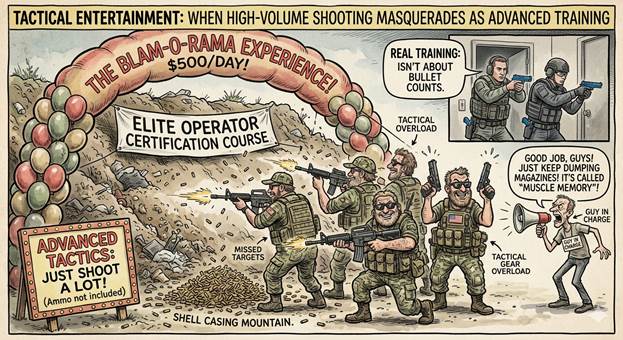
In my opinion, short-duration, high-volume shooting events fall into the realm of what I refer to as “Tactical Entertainment” – a format where flash and volume substitute for genuine skill development. This is especially true where there is no measurable assessment of shooter ability involved during the attendee selection process, nor is skill development quantified beyond one’s ability to load magazines fast enough to support the volume of fire. “Barrel to Berm” – firing continuously from the shooting position to the backstop – in a fast, loud, and exciting fashion provides a dopamine hit that may feel like progress, even where technique may be suffering. To put it in perspective, firing 2.5 rounds every minute for four hours straight leaves very little time for technique explanation, instructor demonstrations, Q&A opportunities, and student diagnostics. While the shooter probably has “fun,” very little learning has taken place.
This problem is compounded when such an event is specifically marketed as advanced training. To most, advanced shooting entails engaging multiple or moving targets, shooting while moving, firing multiple shots during compressed timeframes, working through various weapon stoppages, tactical building clearance, shoot or no-shoot decision making, shooting from cover, shooting from unconventional positions, and similar complex scenarios. During courses of this type, safety is of paramount concern – especially where multiple shooters are firing simultaneously. Inexperienced shooters often struggle with muzzle discipline as course complexity increases. When mixed with experienced shooters, unintentional flagging often occurs. When an instructor is constantly distracted correcting a novice’s fundamental errors, no one is supervising the advanced shooters performing complex maneuvers. These elements combine to create a training environment that quickly becomes unproductive and potentially unsafe.
When instructors are constantly catering to the “lowest common denominator,” many of their students are left behind. Beginners may feel rushed to keep up with the group tempo, leading them to prioritize speed over proper technique and safety. If a student has not mastered the fundamentals to the point of unconscious competence, they aren’t actually learning anything “advanced” – they are merely trying to keep up with the rest of the group. Advanced students may find the pace too slow or the drills too simple, leading to boredom and a lack of skill development. Keeping training “mission specific,” with a baseline skill assessment, highlights the fact that students must already possess mastery of the required skills to get anything meaningful out of the session.
A truly advanced instructor would strive to refrain from providing students with a false sense of security based merely upon the title of a course. When continued assessment is not provided, students will leave believing they have achieved an “advanced” skill set – when in reality, all they did was spend four hours reinforcing bad habits under stress.
True “advanced” work is usually exhausting because of the mental focus required, not the quantity of empty casings left lying on the ground.
Key Points:
- High round counts and short durations prioritize entertainment over learning
- Marketing such events as “advanced training” creates a false sense of achievement
- Mixed skill levels compromise both safety and development
- Without baseline assessment and ongoing diagnostics, students leave having reinforced bad habits rather than building new skills
- True advanced training demands mental rigor, not ammunition volume
End of rant.
“There is a difference between advanced training and training on advanced things.” – John Hearne
Semper Optimum




Leave a Reply