
Article Submitted By: Leo H.
In January of 2025, the Georgia Peace Officer Standards and Training Council (POST) initiated a new twenty-week curriculum for the Basic Law Enforcement Training Course (BLETC). Beyond several other timely modifications; the new program expanded firearms related material from forty-eight hours (408-hour BLETC to include JPS) to one-hundred and sixty-six hours; if “advanced” firearms skills, patrol rifle training, Advanced Law Enforcement Rapid Response Training (ALERRT), Judgmental Pistol Shooting (JPS), and scenario-based training are factored into the allotted time frame. While program based low-light training is still included as a viable element; shotgun familiarization was, unfortunately, removed from the agenda. In my opinion, while the program now allows substantial trigger time which permits the mandate student to further develop handgun and introduce rifle skills, the opportunity to create adequate measurable “standards” fell short of the mark.
I believe POST staff, faced with the development of the new curriculum, did a remarkable job in the short time frame they were allotted to complete a monumental task. They reached out to a small sub-committee of individuals actively involved in Georgia law enforcement firearms training for thoughts and suggestions. Material was compiled and submitted to a formal firearms committee who then made the final determination as to course content and approval of a handgun “qualification” course meant to measure recruit ability. As of this writing (while the new curriculum is in place and being taught throughout the State), I have no idea what the final committee determined to be “advanced” firearms skills. I can, however, share the new “qualification” course (PDF Download from POST) designed to validate entry level handgun skills.
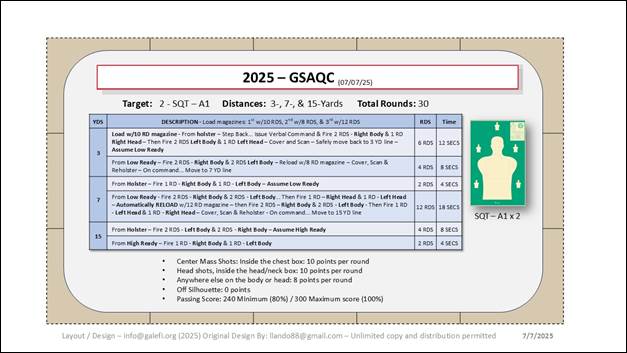
Insert opinion here… While it is nice to have change when the need arises, this “qualification” course did not substantially add to the BLETC program beyond diminished complexity of measured skillset. The low-ready position was added and two additional precision shots were included at the three-yard line. While rearward movement at three-yards remains, lateral movement formerly included in the seven-yard line sequence has been removed. In addition, movement to cover and from the standing to kneeling position at the fifteen-yard line have been eliminated. Finally, the twenty-five-yard line has been omitted from the course entirely. Course commands are a bit confusing and require careful attention on the part of the student as shot sequencing follows differing patterns within the same firing sequence. On the positive side, I believe we will see an increase in successful student “qualifications” … which may have been the desired outcome.
I would have liked to have seen the establishment of newer standards at the mandate level rather than merely rehashing those from past qualifications. Range time for many officers throughout Georgia is merely the firing of the entry course established by POST. As agencies worry about the possibility of losing officers who fail to qualify… many will simply continue to use the entry level course to meet the annual POST requirement to “requalify” their officers. POST recognizes this as a limitation and has posted a listing of new minimum standards for agency sponsored annual firearms requalification on their website. These standards permit the agency to develop courses which more accurately reflect the skills necessary when dealing with real-world encounters while still meeting annual POST requirements.
I would have also liked to have seen the development of a new target. The SQT-A1 has been around for a bit and the scoring zones are benevolent (perhaps “new” is not economical during a time when budgets are tight). If the “qualification” course is to be simplistic in design, perhaps stricter scoring would be in order. One of my pet peeves is to witness students merely shooting to ensure they have fired the allotted rounds, within a prescribed timeframe, rather than taking the time to ensure each shot hits their intended target. I am a firm believer that it is better to hold a bullet than to fire a miss. The time allotted for each shot in this new course is extremely generous. Accountability would be better established with the penalty of disqualification for shots that have been fired without striking any scoring zone on the target. According to the “Lawsuit Information Center,” the average settlement for a gunshot injury is $727,852.00 per shot. While there is probably adequate dialogue concerning missed shots in the classroom, and range rules commonly advise you to “be sure of your target and what is beyond it,” if the shooter is not held accountable for shots that have clearly missed their anticipated target (especially where the allotted times are so prolonged) are we truly teaching shot accountability? I think not.
The expansion of overall range time is much needed and appreciated. However, where the only measurement of a skill set is the simplistic course outlined above, we may be generating additional training issues with student exposure to technique through repetition if some means of measurement is not involved. Merely ticking a box labeled, “Advanced Firearms Training” could be opening Pandora’s Box at the departmental level once a recruit has successfully graduated and returned to the agency. Sometimes, more is not better. I wonder at the concept of “advanced” range skills following so closely after a minimalistic scoring on an entry level course. I suppose only time will tell to that regard.
I hope this article did not come across as too negative. I have no issue with the “standards” being whatever POST deems as appropriate. I also am happy to see we are looking into the future and trying to address the inadequacies of our former training regime. I know the new program is currently in a state of flux as academies expose students to the latest material and assess the effectiveness of the training. Together we must all strive to continue to push forward with our thoughts and design to best prepare our students to prevail when they are faced with circumstance requiring effective use of their firearms skills.
“A teacher is never a giver of truth; he is a guide, a pointer to the truth that each student must find for himself.” – Bruce Lee
Semper Optimum!


Leave a Reply