
Article By: Leo H.
Dispatched to a suspicious person call, Officer Friendly, a popular seven-year veteran and incident report writer without peer, found himself in a deadly force encounter behind a local convenience store. The shadow he encountered raised a weapon. Friendly drew. His hands shook. His grip faltered. The fundamentals he’d “qualified” on six months earlier evaporated in the moment.
He fired. He missed. Three times. After all, in his mind, this sort of thing was never going to happen to him.
Fortunately, backup arrived, successfully ending the situation. Friendly survived. But in the after-action review, the departmental firearms instructors asked themselves the question: “What if the reason he couldn’t perform under stress wasn’t his fault – but mine?”
The Assembly Line Problem
Many law enforcement firearms training sessions follow a familiar pattern. A classroom lecture explains the process. An instructor effectively demonstrates the Drill-of-the-Day, which is often a rendering of the current “YouTube Wonder Drill” making the rounds. A group of shooters lines up at the designated distance. Then everyone shoots until the allotted number of bullets is fired. Everyone moves on to the next drill.
At the end of the day, those who did well smile and leave. Those who “just didn’t get it” frown and leave. Some may get scheduled for remediation. Come time for the annual “qualification,” some will and some won’t.
I call it Assembly Line Training. We’re treating skill acquisition like we’re building cars on a factory floor. Same process, same timeline, same round count for everyone. And then we act surprised when we folks can’t qualify… year after year.
The Perpetual Remedial Shooter
Here’s a fact every good law enforcement firearms instructor knows, but few want to admit: roughly 15-20% of officers become perpetual remedial shooters. They barely scrape through qualification year after year, consuming disproportionate training resources, and representing the highest liability risk on the force.
Why do they stay remedial?
The conventional answer blames the officer: lack of practice, poor fundamentals, mental blocks. But a growing number of progressive trainers are asking a more uncomfortable question: What if we’re teaching them to fail?
Enter the Question of Competency
The answer lies in research that’s been hiding in plain sight for decades. Educational psychologists identified it in the 1970s. Olympic athletes have been using it since the 1980s. Corporate trainers adopted it in the 1990s. Yet somehow, law enforcement firearms training remains stuck in a 1950s model.
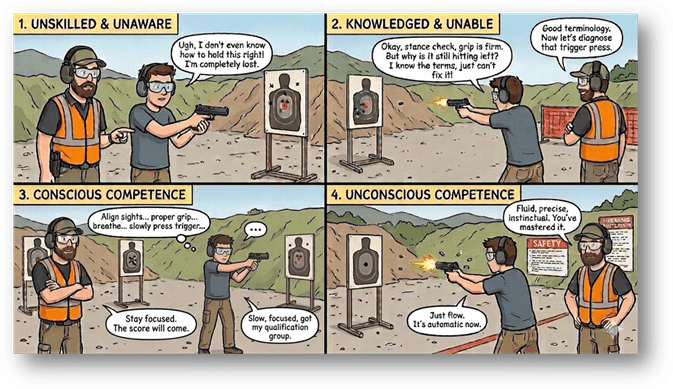
The framework is called the Stages of Competence, and it reveals why checkbox training fails.
Stage 1: Unconscious-Incompetence
“They don’t know what they don’t know.”
The rookie who’s never fired a gun enters your program. They have no frame of reference, no understanding of what “good” looks like. Traditional training throws them on the line, runs through the checklist, and hopes something sticks.
Competency-based training recognizes that these shooters need individualized attention to build a foundational understanding. Pushing them through the standard program almost guarantees they’ll become your future remedial problems.
Stage 2: Conscious-Incompetence
“They know the terms but can’t self-diagnose.”
These officers can tell you what grip, sight picture, and trigger control mean. They can even string together a qualifying score—sometimes. But when they fail, they have no idea why. They parrot whatever the instructor has been whispering in their ear, but lack true understanding.
Stage 3: Conscious-Competence
“They qualify reliably but must think through each step.”
Here’s where most training programs stop. These officers can pass “qualification” with conscious effort. They’re “good enough.” But under stress? When the conscious mind shuts down, and the sympathetic nervous system takes over? They revert to whatever’s been drilled into their subconscious—which may be nothing more than barely passing qualification scores.
Stage 4: Unconscious-Competence
“They perform without thinking.”
This is the goal. Smooth, automatic responses under pressure. But traditional training rarely gets officers here because it focuses on covering content rather than achieving mastery.
Stage 5: Reflective-Competence
“They understand the ‘why’ and can train others.”
Your future instructors. The ones who don’t just do—they understand the underlying principles and can adapt them to new situations.
The 4% Rule That Changes Everything
Olympic shooting champion Lanny Bassham discovered something remarkable after winning silver in 1972 and feeling like a failure. He interviewed gold medalists to find out what they did differently. The answer became his Mental Management® system, and one principle stands out:
Self-Image and performance are always equal. This means your performance will never exceed the level of how you view yourself; to improve your results, you must first change your Self-Image.
Research by psychologist Mihály Csíkszentmihályi identifies what is now referred to as the 4% Rule. The principle is elegantly simple: humans learn optimally when challenged about 4% beyond their current capability.
Too easy? Boredom. Attention wanders. No skill growth.
Too hard? Anxiety. Shutdown. Negative training experiences.
Just right—that sweet 4% stretch? Flow state. Peak learning. Skill advancement.
Here’s the problem: most qualification courses aren’t designed around the 4% Rule. They’re designed around administrative convenience. Can we get 30 officers through in one day? Does it meet POST requirements? Does it limit department liability?
Nobody’s asking: Is this actually building competency?
Why Your Range Time Is Backwards
Neuroscience research reveals something training officers need to learn to accept: The brain needs time to consolidate new motor skills.
When you learn something new, your hippocampus holds it temporarily. During sleep – specifically during the replay that happens in slow-wave sleep – those patterns get transferred to long-term storage in the neocortex. This process takes about 24 hours.
Yet how do most departments structure training?
Day 1: A Range DAY – Eight hours of instruction and live fire
Day 2: DAY TWO – Eight hours, building on “yesterday’s foundation”
Day 3: Many, many, attempts at “Qualification”
Except there is no foundation from yesterday. Neural consolidation hasn’t happened yet. You’re trying to build a second story before the concrete has cured on the first floor.
Competency-based programs structure training in chunks—intense training sessions with 24-hour breaks in between. They “prime” students with material before introducing new concepts. They align with how the human brain actually works, not how the training calendar fits together. You don’t move on to Step Two until you can perform Step One to an identified standard.
The Percentage Pitfall
Here’s a question that makes legal departments nervous: Why do you document exact qualification scores?
“Officer Friendly shot 82% on Course of Fire.”
Now Officer Friendly is involved in a shooting. The plaintiff’s attorney subpoenas training records. “So, Officer Friendly barely passed your qualification at 82%—just two points above your 80% minimum. And you sent him onto the streets to make life-and-death decisions with a firearm. Isn’t it true that nearly a quarter of his shots miss the target, in a controlled, stress-free environment, almost every time he shoots?”
An alternative: Document as “SP” (Structured Practice) or “NSP” (Non-Structured Practice) with a simple pass/fail notation. POST doesn’t require percentages. They require pass/fail. So why provide ammo to the plaintiff’s attorney?
Better yet: Stop thinking about qualification as a single event. Make it continuous through Task-Oriented Qualification Courses (TOQCs) – brief, objective assessments after each training session that must be passed to advance to the next step.
The Three-Strike Rule
What do you do when a student shuts down? Won’t follow instructions? Clearly has checked out mentally?
My approach: the Baseball Rule.
Provide corrective instruction three times. If they fail to follow, ask: “Do you understand what I said about (specific technique)?” If yes, ask: “Do you have any questions?” If not, stop instructing. Monitor for safety only. Document and inform accordingly.
It sounds harsh. But it’s honest. Some officers don’t want to be there. Some are comfortable with mediocrity. If there’s no administrative consequence for perpetual failure, some will happily collect remediation pay year after year.
If you have the authority, send them on their way. Practicing improper technique will never lead to competency. A desire to learn or develop greater skills is a required element of a progressive training program.
Competency-based training isn’t for everyone. It requires individual accountability. It demands consequences. And it accepts something uncomfortable: not everyone should carry a badge and gun.
What Actually Works
The competency revolution isn’t theoretical. Progressive instructors are implementing these principles:
Pre-training priming: Send training material before range day. Let the students’ brains start processing new concepts and information beforehand.
Small-group, ability-based cohorts: Stop trying to train rookies and veterans together. Group by competency level.
Short, intense sessions: 200-250 rounds maximum. Structured for a 70-80% success rate (the 4% Rule zone).
24-hour spacing: Let sleep work its magic.
Multi-modal instruction: Visual learners need demonstrations. Auditory learners need explanation. Kinesthetic learners need to do. Hit all three (the VARK model).
Continuous assessment: TOQC after each evolution. Pass within two attempts or repeat the material… perhaps at a slower pace.
Positive reinforcement: Build self-image. Document progress. Focus on what’s working, not just what’s failing.
Notebook method: After demonstration, ask students what they heard you say… Ask what they saw. Have them write it down. The more senses engaged, the deeper the learning. The more you think about, talk about, and write about something, the higher the probability you’ll understand it (Bassham).
A Simple Test of Competency
Ken Hackathorn, a legendary firearms instructor, developed what he calls “The Test.” It’s brilliant in its simplicity:
- 10 rounds
- 10 yards
- 10 seconds
- B-8 repair center target (or IPSC/IDPA head box)
That’s it. Ten seconds of shooting that measures draw stroke, grip, sight picture, trigger control, accuracy, speed, recoil management, visual focus, and mental focus.
No complex course of fire. No elaborate scoring. Just: can you perform the fundamentals under time pressure?
If you can’t pass “The Test,” you’re not competent. If you can pass it consistently, you’ve got the foundation to build more complex skills.
The 90% Mental Truth
“Shooting is 90% mental.”
Everyone in law enforcement has heard this. Few train for it.
Mental Management, flow states, visualization training, self-image building, pressure inoculation – these aren’t soft skills. They’re the skills that separate officers who perform well under stress from those who can’t.
Lanny Bassham’s three-tier improvement process is simple:
- Set specific training session goals
- Analyze session results
- Compare with overall goal-driven expectations
Keep a training journal. Document the mental game. Because when bullets start flying, you generally don’t rise to the occasion – you default to your training. And if that training is eight hours of shooting at paper with no mental preparation or accountability, it’s no wonder Officer Friendly missed.
The Uncomfortable Question
So what if the reason your officers don’t qualify is you?
Not you personally. But the system. The checklist. The assembly line. The administrative convenience over actual learning. The comfort with “good enough.” The tolerance of perpetual mediocrity.
Competency-based training is harder. It requires more instructor skill. It demands individualized attention. It needs administrative backing for accountability measures. It costs more time per student (though potentially less overall through reduced remediation).
But here’s what it delivers: officers who can actually perform when it matters.
Not officers who barely scraped through qualification six months ago.
Officers who’ve achieved unconscious competence. Who’ve trained in flow states. Who’ve consolidated skills through proper spacing. Who’ve built positive self-image and mental resilience. Who understand not just what to do but why.
Officers who, when that “Suspicious Person” call comes, don’t freeze. Don’t fumble. Don’t miss.
Officers who then go home alive.
A Path Forward
Competency reform isn’t just a concept that might work I’d given the chance. Progressive departments are already implementing these principles. They’re seeing reduced remediation rates, higher qualification scores, better performance in force-on-force scenarios, and fewer critical incidents resulting from shooting failures.
The research is clear. The methodology is proven. The results are documented.
Ask yourself: Do I conduct training to check a box, or do I train to save lives?
Final Thoughts: Five Signs Your Program Needs Competency Reform
- Same remedial faces every year – If you’re seeing the same 15-20% of officers in remediation annually, your initial training is failing them.
- Officers who qualify can’t explain why – Ask an officer how they shot well. If they can’t articulate what they did right, they’re in Stage 2, at best.
- High performance at quals, poor performance in scenarios – Qualification isn’t the goal. Performance under stress is. If there’s a gap, your training isn’t translating.
- Instructors blame students – “They don’t practice enough.” Maybe. Or maybe your training didn’t give them tools for self-directed improvement. Be honest.
- No progression path – If every training session is a “fundamentals review,” you’re not building competency. You’re maintaining incompetence.
“Perfection is not attainable, but if we chase perfection we can catch excellence.” – Vince Lombardi
Semper Optimum


Leave a comment