
Part Two…
Article By: Leo H.
Having survived a brief history of electronic optics in Part One and having concluded that law enforcement has begun to formally embrace the concept of RDS as a duty weapon consideration, I felt the next logical step was to look at the pros and cons of RDS use from a personal perspective.
Throughout my career as a trainer, I have made effort to remain abreast of current trends in firearms and ammunition development, related tools and technology, and the training trends applied by whomever I viewed as a relevant trainer servicing the law enforcement market. As a result, I have spent a considerable amount of personal time and money in pursuit of such in order to assess the impact of these items in the realm of performance enhancement as it relates to law enforcement implementation.
As I have gotten older, I have specifically searched for tools, tactics, or technique that will provide any sort of advantage that is vision based as I moved into the bifocal and then progressive lenses era of my life. Thus, electronic aiming systems moved to the forefront as front sight focus became a slow process involving much up and down head movement. And too, I felt that any tool or concept that could help me would also be beneficial to assisting the beginning and remedial shooters I had the opportunity to work with as a firearms instructor.
As with most instances when I have no clue about things, I turned to my good friends at Google for information. We must, of course, realize Google is not 100% accurate… and so… I generally use links found during my searches as a point to begin more focused research. However, I am a firm believer in “not reinventing the wheel” and commonly accept the opinion of those I recognize as a peer as my focal point in instances where their knowledge mirrors my interest.
Such was the case in my early searches for information on the RDS dilemma. Google led me to Karl Rehn of KR Training in Texas for his take. I have been an avid reader of his blog and used his online reference to courses of fire (LINK) for many years. His blog article entitled, “Red Dot Study – Key Points” can be found HERE.
While the study was conducted in 2017, and much has improved in the realm of RDS as it relates to duty carry since then, I found the included information insightful and relevant. During his two-year study, he used the results of 118 shooters (male and female participants – 18 to 76 YOA) who were ranked from novice to IDPA Grand Master. His area of interest was that of defensive shooting with data calculated based upon one shot at a IDPA target (scoring as seen on the image below) from the ready position within 1.5 seconds. Scoring was obtained from 5 and 10 yards.
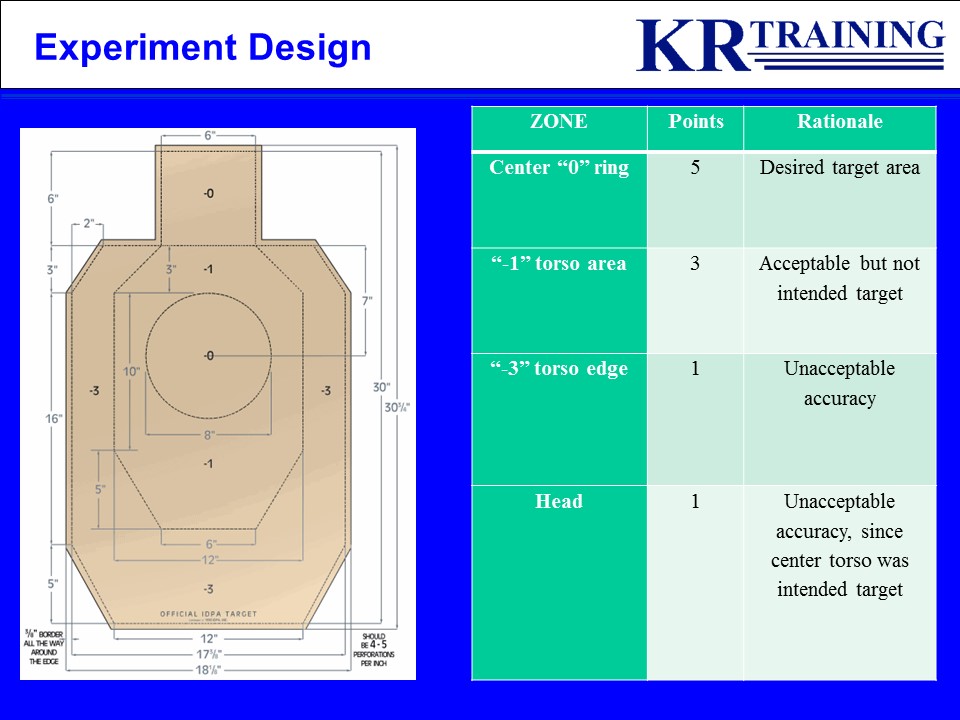
The study was intended to address whether using slide mounted optics provided better results than using a laser or iron sights. His conclusion… NO.
Side Note: Around 2016, I purchased a RDS and mounted it on a Glock 22. I used a mount that fit the factory dovetail which put the optic slightly above the slide (this is where I learned you needed a milled slide). After a short dry drill session, I used the gun to run several recruits through the State course of the time. While they did make several more hits from distance than they had with iron sights, their scores did not reflect an observable difference in accuracy. I tabled RDS interest until I was able to purchase a MOS ready gun.
The KR Training study provided no formal training to the participants prior to the test. All shooters expressed having trouble finding the dot, especially without backup sights. While the participants shooting a red dot did become more proficient with practice; it was found that green dots seemed to work better in daylight. Of the test participants, it was found experience and skill provided the foundation for better results with instructor level users having the best overall success. No significant improvement in score was shown among those testing who had vision issues.
A look at the United States Practical Shooting Association (USPSA) statistics generally shows less than a 10% advantage to shooters using RDS. Of course, a 10% advantage in a gunfight could make all the difference between winning and losing and the same advantage realized by a BLETC shooter, who scored a 73% on a qualifying run with iron sights, could mean a qualifying run of 80% with RDS… all other things being perfect.
Further research found an article written for American Handgunner magazine by Massad Ayoob stating the first field use of a RDS in the law enforcement community occurred in 2017. In that article, he also references a RDS Study compiled by Jason Wuestenberg (will be a speaker at the 2024 GALEFI Annual Training Seminar) of the National Law Enforcement Firearms Instructors Association (NLEFIA) which indicated the small data sample available at the time (2020) suggests a hit ratio of 52% with RDS while iron sighted fire returned a 40% hit ratio in actual law enforcement deadly force encounters during the same time span.
The study by NLEFIA will continue gathering data through the end of 2024. Use this LINK to submit your data.
Compiling a short Pro/Con list from various online sources provided these points:
PRO
- The human eye can only focus on one thing at a time and on a single focal plane
- During violent encounters, defensive shooters tend to be “threat focused”
- Correct usage of iron sights requires focusing upon a specific point along three focal planes
- Dots are easy to use and may be simpler for a beginning shooter to learn
- Dots permit faster transitions between targets
- Dots seem to allow greater accuracy with speed at greater distances once fundamentals have been adequately learned
- Although individuals suffering from astigmatism may have issues with Dots, many older shooters with prescription lenses profess to shoot better with Dots
- May enhance shooting performance as much as 10%
CON
- Expensive
- Must be properly installed
- Must be properly maintained
- Must remember to replace batteries
- More fragile than iron sights
- Mounting plates and screws can break
- Dot can “wash-out” due to adverse lighting conditions
- Weather/Environmental conditions can obscure emitter
- Can negate with closed emitter optic – additional expense
- Currently, holster options are somewhat limited
- Requires specialty training from a competent instructor
- Can be difficult for seasoned officers to learn
- Co-witnessing can help alleviate this issue
With the news my old department would begin implementing an optic program (2023), I finally decided I would have to dive into the RDS thing a bit deeper if I was still going to assist on the range.
My T&E program began with online research which delved into training/learning points suggested by various articles and forums. These suggestions led to the viewing of videos by some of the leading shooters/instructors currently active in the areas of competitive and defensive shooting. The various opinions and concepts they offered assisted me in determining which weapons and optics I wanted to train with. Following a period of equipment acquisition (it took a bit to find holsters for everything), I attended a GALEFI H.O.T.S. session on pistol mounted optics (will be offered Monday at the 2024 Annual Training Seminar) and then the first day lecture/range session offered by Clayton County PD in their first transitional class (I did not attend day two as it also provided instruction/drills on a weapon mounted light they were also transitioning to). I then felt I had enough information and related skill set to begin a personal skill development program.
To implement my training regime, I purchased/modified a Springfield 1911, Sig 320 and 365, and a Glock 45. I bought Trijicon, Holosun and SIG optics to include large and small viewing windows (all are open emitter optics). These sights offered dots from 3 to 6.25 MOA. Both red and green emitters were utilized.
The primary focus of my evaluation was to determine if RDS would prove beneficial to shot placement when shooting with a visual deficiency (I am near-sighted with an extreme astigmatism in my left eye); enhance shooting/targeting speed; or produce any other significant observable improvement in my shooting ability.
My program consisted of dry-fire training (predominance); live-fire sessions of no more than 200 rounds each (intending to replicate what most LE shooters experience during departmental training events); and firing the State course (I admit perhaps not the best measure of accomplishment) as a means of quantifying results. While I did shoot with iron sights during the “measurement” rounds, I did not fire the same drills during each personal “training” session as I had fired the same drills many times in the past with standard sights.
My observations were as follows:
- I spent a lot of money
- There is a learning curve
- The Glock seemed to take the longest to adapt to
- The distance you zero from matters
- Shooting with a Dot is fun
- No significant scoring difference when comparing iron vs. optic was observed (State Course)
- Finding the Dot is all about presentation
- Pushing toward the target, rather than lifting into the target, from the holster
- I lost the Dot most often following a reload (need to modify technique and work on this)
- Based upon a timer, I was slightly faster transitioning targets with the dot
- I saw no significant time enhancement from the holster in the 3 to 10-yard ranges
- I was slightly more accurate from 10 to 25 yards
- I was much more accurate/quicker from 25 to 50 yards
- I found, for me, the larger dot worked better up close with the smaller Dot working best at distance/group tightness
- I am not sure if this is due to vision or lack of proficiency (I still need a lot of trigger time)
- I saw no great improvement with one window type over another
- Green was easiest to see during the sessions (daylight) I conducted
- I did no low light training
- While I had no issue “seeing” the Dot, my astigmatism caused it to “bloom” no matter who the manufacturer might be or how bright/dull I may have chosen to set the brightness
- However, I have the same “blurring” issue with front sight focus on the irons
- It was far easier to “see” the Dot while wearing progressive lenses than it was to find the sight when shooting with irons
- Being near-sighted, my prescription works very well requiring no head movement to remain threat-focused
- Progressive lenses require an up and down head movement to focus clearly on the front sight of weapons fitted with iron sights
- I decided to see how long the batteries will last before replacement and have over a year on all the sights with no failures
- Adding an optic may cause issues with concealment in an Every-Day-Carry (EDC) sense
- I still use irons on my EDC as I do not feel comfortable with the RDS, yet
- Thus far, I have experienced nothing that would cause me to give a negative opinion of RDS
- Further training/research is in order
So, to RDS or not. Personally, I do not find significant evidence of enhancement relative to cost and would render the opinion duty carry should be a personal choice. If you are one of the shooters of whose confidence in your ability has been multiplied by the addition of RDS to your duty pistol such expense may be well worth it (especially if the department is handling the purchase). I guess the issue that gives me the greatest amount of pause is the fact we are talking about a piece of technology driven equipment. Now, the “in” thing is a closed emitter optic – thus rendering everything I have purchased obsolete. Who would a thought?
Dots are not magic. A poor shooter will continue to be a poor shooter. Maybe all that really matters is the amount of time you are willing to spend gaining the knowledge, skill and ability required to master the technique… be the gun mounted with an optic or irons.
Yesterday I was clever, so I wanted to change the world. Today, I am wise, so I am changing myself. – Rumi
Semper Optimum!




 Thinking Man's Corner
Leave a reply to Weekend Knowledge Dump- March 8, 2024 | Active Response Training Cancel reply