
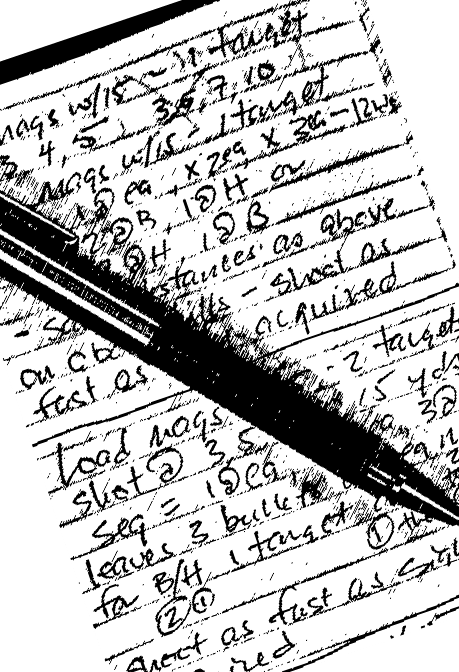
Keep a Journal
Written By: Leo H.
With a new year upon us, I thought it could be appropriate to begin the year with a new habit intended to assist us in becoming better instructors and enhancing our personal abilities on as may other levels as might be possible. To that end, I would suggest that you consider keeping a professional journal throughout this year.
I attended a training liability class, at some point in my past, where the instructor made the statement, “The courts have said, on many occasions, if it’s not written, it didn’t happen.” Personally, I have no desire to be the defendant in a test case intended to prove that statement wrong. Where the content of a training class becomes scrutinized due to some injurious event that has pulled you into a civil courtroom, how much information is available to you when developing your defense for the material you presented?
While I intend to add many more words to this article, the title serves as fulfilling content. I am not the most prolific of all journal writers. However, I do document things that… have happened, or I want to happen, or that I have thought about, or that I’d like to think more about, or caught my interest in some way, or… I think you get the idea.
By jotting notes, that have some sort of order, you’ll have the ability to revisit past occurrences in order to avoid repeating them if the outcome was bad… or repeat them if you liked the outcome… or learn more in the hope of better performance. Journal writing has worked for quite a number of folks much more important or influential than me and is often recognized as one of the traits associated with fame and fortune. If nothing else, you may find you enjoy the writing part and will be amazed at what you originally missed when you revisit your notes for the second or third time. While the gist of my writing here is aimed at a performance journal for shooters, a journal can be kept for almost anything. The benefits of journaling abound.
Consider the fact quite a bit of data suggests journaling has great mental and emotional benefit. Often, professional counselors suggest and encourage patients to journal just for the impact it can have on your self-esteem. The enhancement of your self-esteem alone can have a great positive impact upon your shooting performance. Instead of “I think I can… I KNOW I can” always leads toward higher standards of performance. The greater the emotion you can tie to specific aspects of your performance… the more probable the possibility you will desire to replicate them. Always ensure you have recorded the thoughts and feelings associated with your performance rather than simply documenting the final outcome to lock in to this valuable resource.
From a creative perspective, keeping a journal can help you learn to process and communicate complex thoughts in a more effective fashion. You will analyze your training experience to greater depths relative to the effort you’ve put into thinking exactly what you will put to paper. Observations and ideas you may not have even considered while at the range will emerge to better formulate your future range sessions and remodel your training regime.
Excellent performance is all about limiting mistakes while maximizing outstanding achievements. Many times, peak performance is directly related to ensuring habits and traits associated with winning are in the forefront of our training plan. Beyond the specific areas of interest we’ll cover in just a moment as we look over my example of a training journal, items such as diet, rest and daily stressors which can also have an impact on our performance can be identified and amended when they have been properly documented.
In the past, I developed a performance journal to assist the students I trained by providing a means of creating a permanent document of their training efforts. My intent was to use the journal to accelerate the learning process by offering the student an easy point of reference written in their own words. Beyond that, If each student used a similar format, it would make it much easier for me (as a coach) to evaluate their progress and give sound advice. You can find a copy of that journal HERE. In the paragraphs below, I’ll explain my intent for each section in greater detail. If you have an interest, feel free to download, print and use the page to your heart’s content.
The “General Information” section provides the student with a permanent record of the date, time and location of each training session. I thought it important to include a means of documenting training videos which might have been viewed or any printed material which may have been read, as well. In addition, this section also tracks training cost for appropriate budgeting and/or tax write-off considerations.
The next section, “Weapon Information,” is intended to document which weapon the student trained with on any particular day. It is my belief training sessions should be focused on a single type of weapon system (handgun, rifle or shotgun) during each individual session rather than using the “more is better” approach. I also try to limit a training session to approximately 250 rounds as I find most students tend to lose focus as they become tired. Of course, when you are shooting well, it doesn’t hurt to continue to press the trigger until the scores decline!
It also doesn’t hurt to keep a maintenance record for reach of your weapons. Think of your gunsmith as a “gun doctor.” If your guns get “sick,” it’s nice to have a detailed record of what they’ve been up to so you can make an educated decision as to what should be done to get them up and running again.
The “Activity” section reflects the type of training performed by the student. It is quite possible to conduct multiple activities in a single session. In fact, it would be of great benefit to ensure you train, at least annually, in the majority of the choices listed in the second and third columns. The instructor signature block provides a permanent record of an independent evaluator of your training progress. A signature on that line could prove extremely beneficial in a courtroom at some point in your life. The block can also be used to write-in the title of a pertinent book or the name of the video or YouTube segment you just watched. It’s all important.
The “Conditions” where you may be called upon to lawfully use your firearm will vary. It would stand to reason you should try to train in as many different environments as you could realistically expect to be faced while carrying your weapon. Don’t be the guy who stays home because “it’s cold; or windy; or raining today.” Weather, layers of clothing, holster type and positioning, varying sighting systems, lighting conditions and body position can all influence weapon handling. Don’t let the emergency situation you are currently involved in be on-the-job-training. A prevailing mindset does not count on luck to succeed.
Obviously, this record is intended to track your firearms training history. Under “Target Information” you must therefore show how you are tracking your accuracy. What where you shooting at? How was the target scored? How many targets (to include friend/foe) did you have to process to successfully navigate the course? If your intent is to enhance your performance, you don’t just go to the range and shoot. You should always go to the range with a specific plan intended to achieve a specific purpose.
In the beginning, the next section was simply entitled “Notes.” However, that all changed when I read the book, “With Winning in Mind” by Lanny Bassham. I then found the missing elements needed to complete my journal design. When writing notes, folks often just put words to paper with no specific focus. Following that path does lead to documentation. However, it seldom provides the emphasis needed to properly recognize superior behavior and plan for its repetition or identify faults and provide adequate direction for improved performance.
The topic headings, “Session Performance Goal,” “Performance Analysis,” and “Solution Analysis” forces the writer to focus on specific issues during the journaling session. A written goal leads to a specific training plan. The training plan requires realistic assessment of performance in order to identify progress. Positive or negative traits feed the new training plan and the path to improvement is paved by hard work and dedication.
“Your Defensive Handgun Training Program” is an excellent book written by Michael Seeklander (Professional Shooter and former LE Trainer @ http://www.shooting-performance.com) which you should consider adding to your learning library. Chapter 10 discusses documentation and modification of your training. I highly recommend this book. Properly documenting your training program is vitally important.
Of course, you don’t have to use my journal in order to effectively document your training. Putting pen to paper, choosing to use journaling or diary apps, or blogging all serve as a means to preserve your thoughts and observations. So… as the Nike ad says… “Just Do It!”
“The greater danger for most of us is not that our aim is too high and we miss it, but that it is too low and we reach it.” – Michelangelo
Semper Optimum!


Leave a comment