
Article By: Sam H. & Leo H.
Spend enough time on ranges with cops, military, and armed citizens, and you start to see the same movie play over and over: shooters get labeled as “untrainable,” “recoil shy,” or “just not a gun person,” when in reality they’ve never had a coach who can demonstrate what right looks like, diagnose what’s going wrong, and then grind through the reps it takes to fix it. The fault lies less in the student and more in how we teach.
The Real Culprit: How We Teach
In many programs, instruction is long on talk and short on results. We bury shooters in jargon—trigger reset, front sight focus, anticipation, pre‑ignition push—then rush them from drill to drill before they’ve mastered anything. What they rarely get is a simple, repeatable process and enough time under a watchful eye to make it stick.
The shooters who struggle the most almost always share the same history: inconsistent coaching, vague or conflicting cues, and very little structured remediation. They don’t need a new miracle technique. They need an instructor who can do three things well:
– Demonstrate exactly what “right” looks like
– Spot the error in real time
– Apply a simple fix and stick with it long enough to change behavior
Grip: The First Non‑Negotiable
If there’s one technical hill worth dying on, it’s grip. A firm, consistent grip throughout the shooting process is the foundation that makes everything else possible. When shooters suddenly “get it,” it’s usually not because someone delivered a brilliant monologue on trigger mechanics—it’s because someone finally showed them how to hold the gun.
The most effective instructors don’t just talk about grip; they put hands on. They’ll physically grab the student’s wrist or firing hand and demonstrate the pressure and direction they’re applying to the gun. That tactile cue often does more in three seconds than three paragraphs of explanation.
Once the student has a solid grip, the instructor’s job is to help them maintain it through the entire string of fire. No relaxing after the first shot, no re‑settling between rounds. One grip, start to finish.
Rethinking Visual Focus
A lot of shooters have been told their entire lives to “focus on the front sight.” That advice is not completely wrong, but in isolation, it often leads to a shooter trying to micro‑manage sight clarity while the gun is bouncing around from poor grip and anticipation.
A more useful approach for many students is simpler: pick a specific spot on the target and look at it. Hard. Accept that your sights may appear slightly blurry, but demand that the gun stay as still as possible as you press the trigger. Instead of obsessing over a razor‑sharp front sight that dances all over the place, you’re anchoring your attention where the bullets need to go and tying it to the one job that matters: don’t move the gun.
The Power of Reps and Dummy Rounds
Talk is cheap; repetitions are where skill is built. Dry fire, dummy rounds, and simple live‑fire drills do the heavy lifting if they’re used correctly.
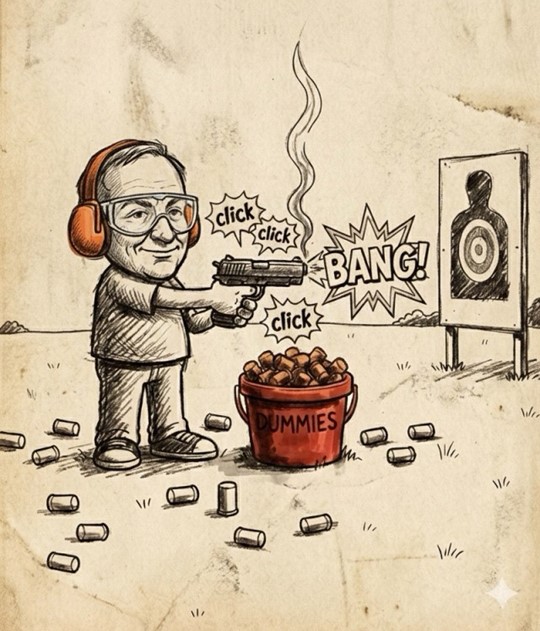
One of the most brutally effective tools for fixing anticipation and low‑left hits (for right‑handed shooters) is what many instructors know as the ball‑and‑dummy or “bucket of dummies” approach. The idea is straightforward:
– Load several magazines with a mix of live and dummy rounds—no more than a couple of live rounds per mag, the rest dummies.
– Run the drill completely untimed. The only goal: hold the gun still as you press the trigger.
– Say very little. When the hammer falls on a dummy and the muzzle dips, the shooter sees their own anticipation in real time.
At that moment, you don’t need a lecture. A simple cue like, “You saw what happened—hold it still with a firm grip while you fire,” is enough. The shooter now has a clear picture of the problem and a single, concrete task to focus on. The rest are reps.
Video: The Quiet Truth‑Teller
Every instructor on a modern range is walking around with a high‑speed coaching tool in their pocket: a smartphone. Video is a gift to serious shooters because it cuts through ego and memory.
When a student insists, “I didn’t move the gun,” a 10‑second clip is all it takes. Film a short string of fire, then stand shoulder‑to‑shoulder and watch it together. They’ll see the gun dip on dummies, the shoulders flinch, the grip relaxing between shots. You don’t have to argue; the video does the talking.
Just as important is having video of “what right looks like.” Slow, clean demos—either from the instructor or trusted shooters like Rob Leatham—show students exactly what they’re trying to replicate: stable gun, efficient grip, smooth trigger, no drama. The less talking over the video, the better. Let the movement speak.
Keep It Simple, Stay Until It’s Fixed
A common failure point in training is the urge to move on too fast. We pile on concepts—trigger reset, speed, movement, reloads, transitions—while the shooter is still struggling to keep rounds on paper at a realistic distance.
A better rule: don’t move on until the current task is truly under control. If the shooter is missing low‑left, today’s mission is simple—fix the low‑left. That means:
– Check the grip
– Check for movement before the shot
– Use dummy rounds and video as needed
– Stay with those basics until the pattern changes
No new drills, no fancy add‑ons. Just honest work on the fundamentals until the hits prove the problem is solved.
The Instructor’s Responsibility
All of this points back to a hard truth: outcomes on the range are largely an instructor problem, not a student problem. If we can’t demonstrate a proper grip, can’t clearly describe the goal in one or two sentences, and can’t design a simple drill to isolate an error, we’re not giving students a fair shot.
A good instructor:
– Shows, doesn’t just tell
– Uses the minimum effective amount of language
– Leans on dummy rounds, video, and volume of reps
– Treats fundamentals as the solution, not the warm‑up
When we do that consistently, the “hopeless” shooters start hitting. The “untrainable” cops suddenly qualify. The recoil‑shy civilian realizes they can run the gun with control and confidence.
Most problem shooters aren’t broken—they just haven’t met the right teacher yet.
“That’s been one of my mantras – focus and simplicity. Simple can be harder than complex: You have to work hard to get your thinking clean to make it simple. But it’s worth it in the end because once you get there, you can move mountains.” – Steve Jobs
Sempur Optimum

 Thinking Man's Corner
Leave a comment