
Article By: Leo H.
The goal remains the same, but the path to the bullseye changes with the mindset of the shooter. To maintain a safe and effective range, instructors must adapt their coaching styles to the unique psychological profiles of the Boomer, Gen X, Millennial, and Gen Z students who fill their classes.
The Core Principle: Adaptation or Failure
Shooting well relies on mastering the laws of physics, but teaching well requires the mantle of a psychologist. Safety is the non-negotiable floor, but your delivery determines the ceiling of a student’s skill. A method that inspires a Baby Boomer will often bore a Gen Z student to tears. Conversely, the high-tech, rapid-fire pace that engages a younger shooter can feel reckless to an older one.
Effective instruction requires a hybrid approach: unified safety standards paired with generational breakout sessions. Highly successful classes are rarely taught by instructors who utilize a “my way or the highway” instructional style.
Coaching the Generations
Instructors must master four distinct coaching styles:
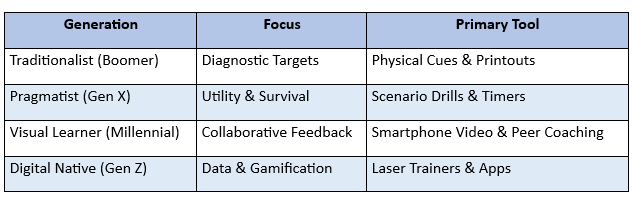
- Baby Boomers seek tradition and the “why” behind the mechanics; they respect authority and formal lectures.
- Generation X wants practical, no-nonsense utility; they ask, “How does this keep me alive?”
- Millennials crave visual feedback and collaborative mentorship; they want to see their mistakes on camera.
- Generation Z lives for the “gamified” experience; they thrive on digital data, shot timers, and micro-lessons.
The Mastery Curriculum
An eight-hour mastery course should be divided into two-hour blocks covering the four pillars:
- Stance: Transition from Boomer-preferred skeletal alignment to the aggressive, athletic drive of Gen Z “operators.”
- Grip: Move from the traditional “handshake” approach to high-tang leverage, using tech like MantisX for objective data.
- Sights: Bridge the gap between iron-sight clarity for traditional shooters and the “target-focused” reality of modern red dots for aging eyes or digital-native students.
- Trigger: Use “Penny Drills” for tactile learners, shot-timer “Gauntlets” for the competitively minded, and SIRT handguns for the gadget-driven.
Managing the Line
Friction is inevitable when generations collide. The instructor must act as a mediator. When a traditionalist scoffs at an optic, frame it as a “force multiplier.” When a young shooter moves too fast, frame safety as “legal liability” and “mechanical efficiency.”
Use the A.A.A. Method:
- Acknowledge the frustration.
- Align the drill with the student’s personal goals.
- Adjust the pace to maintain engagement.
The Instructors Range Kit
The Day is Done
The day ends with a unified capstone. Despite the different drills and digital apps used throughout the day, every student must meet the same objective standard of accuracy and safety. We teach the person to master the machine. Generational preference simply provides the data we need to find the right key for the lock.
“It is genuinely and rightly considered a virtue in a teacher to observe accurately the differences in ability among his pupils, and to discover the direction in which the nature of each particular pupil inclines him.” — Quintilian (c. 90 A.D.).
Semper Optimum


 Thinking Man's Corner
Leave a comment