
Article By: Grok
Edited By: Leo H.
This article was created with assistance from Grok which was used for personal amusement and contemplation. Content has been reviewed and edited by Leo H… Readers are encouraged to verify information and exercise critical judgment. Neither Grok, nor I, have spoken with Wyatt Earp, his family, executors, or heirs, historians, teachers, neighbors, possible witnesses or their descendants, folks with differing opinions, nor Old West scholars and attest this article to be pure speculation and without historical basis or fact.
If Wyatt Earp, the legendary lawman and gambler of the Old West, were alive in 2025, he’d likely adapt his no-nonsense approach to firearms and self-defense to fit modern realities. Historically, Earp favored reliable revolvers like the Colt Single Action Army in .45 caliber, often depicted with a long-barreled Buntline Special variant for added reach and accuracy in gunfights. But in today’s world of advanced technology, urban threats, and evolving laws, he’d prioritize practicality, concealability, and firepower. Drawing from current trends in law enforcement and concealed carry, as well as Earp’s emphasis on deliberate, effective shooting, here’s a reasoned speculation on what he’d carry, how he’d train, and the tactics he’d hone.
The Type of Gun Wyatt Earp Would Carry Today
Earp’s historical choice of the Colt SAA was about reliability in harsh conditions, ease of use, and stopping power—qualities that translate to modern semi-automatic pistols over revolvers for most professionals. Revolvers like modern replicas of his Buntline (e.g., Cimarron’s Wyatt Earp Frontier model) might appeal for nostalgia, but they’d be impractical for everyday carry due to limited capacity (typically 6 rounds) and slower reloads compared to today’s threats involving multiple assailants or high-volume fire.
Instead, Earp would likely opt for a compact or subcompact 9mm semi-automatic pistol, balancing concealability, capacity, and controllability. Top contenders in 2025’s concealed carry market include the SIG Sauer P365 XMacro (with 17+1 rounds and integrated compensator for reduced recoil), Glock 19 Gen 5 (15+1 rounds, renowned for durability and simplicity), or Smith & Wesson M&P Shield EZ (for easier racking if age were a factor, though Earp was tough into his later years). The Glock 19 stands out as a strong fit: It’s the modern equivalent of his Colt—ubiquitous among law enforcement, utterly reliable in dust or mud (echoing frontier conditions), and chambered in 9mm for manageable recoil and ample ammo availability. He’d carry it in a comfortable inside-the-waistband holster, perhaps with a red-dot sight for faster target acquisition, reflecting advancements since his iron-sight days. For backup or variety, a .45 ACP 1911 (a nod to his era’s big-bore preference) could suit him, but 9mm’s higher capacity (15-17 rounds vs. 7-8) would win out for real-world scenarios.
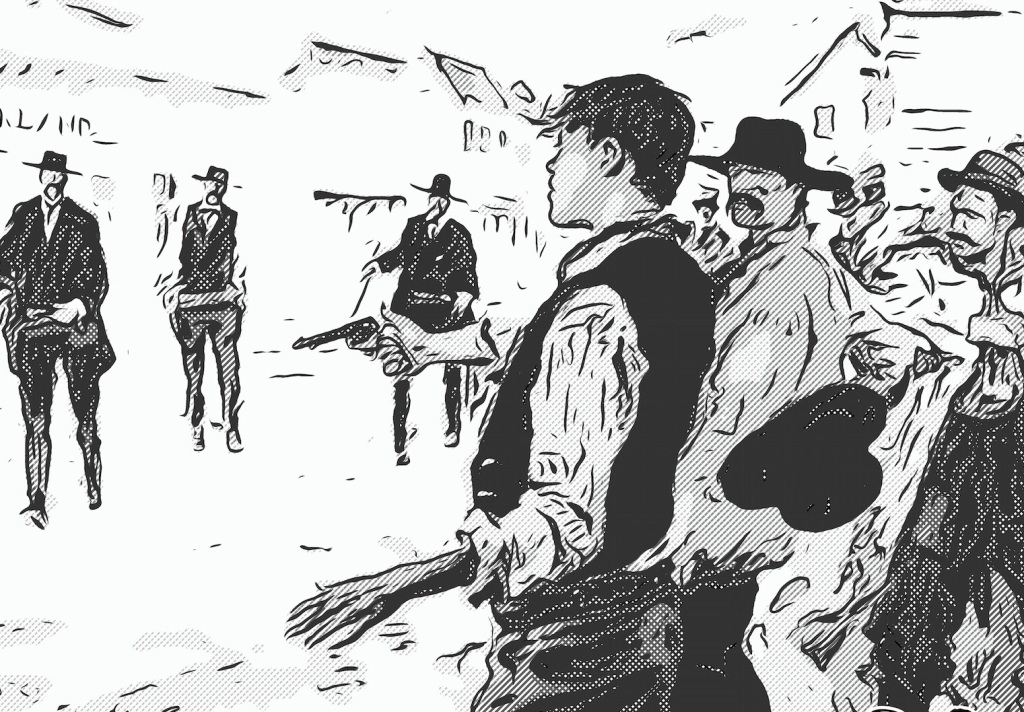
Earp might also appreciate modern “cowboy” twists, like a Ruger Vaquero for range fun, but for daily carry as a hypothetical modern security consultant or private investigator (fitting his post-Tombstone life), it’d be a polymer-framed 9mm striker-fired pistol—proven in high-stakes encounters, just like his SAA at the O.K. Corral.
How Often Wyatt Earp Would Train
Earp wasn’t a formal trainee in his time, but he emphasized practice for accuracy under pressure, reportedly advising to “take your time in a hurry” rather than rushing shots. Today, as someone with a law enforcement mindset, he’d follow rigorous, consistent routines to maintain edge-sharp skills, especially given modern legal scrutiny on use-of-force incidents.
Law enforcement standards provide a baseline: Many agencies require firearms qualification at least annually or biannually, with some mandating quarterly sessions (e.g., 4 times a year) that include live fire, scenario-based drills, and low-light shooting. However, experts recommend more frequent practice for proficiency—dry-fire drills (practicing draws and trigger pulls without ammo) 2-3 times weekly at home, and live-fire range sessions monthly to simulate stress and build muscle memory. Earp, known for his cool head in chaos, would exceed minimums: Weekly dry-fire sessions (10-15 minutes each) focusing on smooth draws and sight alignment, plus bi-weekly or monthly live-fire outings (50-100 rounds) at a range, incorporating movement and decision-making drills. He’d also attend advanced courses annually, emphasizing low-light and close-quarters scenarios—totaling 12-24 training days a year to stay capable and legally defensible. This frequency aligns with serious gun owners who treat firearms as tools requiring constant honing, much like Earp did in the 1880s.
Tactics Wyatt Earp Would Likely Focus On
Earp’s Old West tactics centered on precision over speed: Aiming carefully, using cover (like dodging behind wagons), and avoiding unnecessary risks—lessons from surviving multiple shootouts by being deliberate and composed. Today, he’d blend his earlier philosophies with contemporary self-defense principles, prioritizing avoidance and de-escalation before drawing, given stricter laws on justified force than those he encountered in the past.
Key focuses would include:
• Situational Awareness and Mindset: Always scanning environments for threats, maintaining a “combat triad” of mindset, marksmanship, and gun handling. He’d stress mental preparation—knowing when not to engage—to prevent fights, echoing his advice against bluffing or shooting blindly.
• Precision Shooting and Draw Techniques: Smooth, quick draws from concealment, but with emphasis on sight focus and controlled trigger presses—no “spray and pray.” Modern stances like isosceles for stability, plus follow-up shots for multiple threats, adapting his one-shot accuracy to high-capacity mags.
• Use of Cover and Movement: Unlike static Old West duels, he’d train in dynamic drills—moving to cover, shooting from barricades, and pieing corners—to handle urban ambushes or home invasions. De-escalation tactics, like verbal commands or retreating to a safe room, would be key for legal protection.
• Integrated Skills: Basic hand-to-hand or non-lethal options (e.g., pepper spray) to create distance for drawing, plus low-light and one-handed shooting for realism. He’d avoid heroics, focusing on survival over showdowns.
Ultimately, Earp today would embody timeless wisdom in a high-tech package: A reliable 9mm like the Glock 19, training relentlessly, and utilizing tactics rooted in caution, accuracy, and awareness—thus ensuring he’d still be the one walking away from trouble.

 Thinking Man's Corner
Leave a comment